The Accordion view
The juggernaut of trade and economic news since early April 2025 has introduced a level of uncertainty to financial markets not seen since the COVID pandemic. The dizzying macro, trade, and unemployment events—against a backdrop of high interest rates and stubborn inflation—whipsawed markets. Following Trump’s April 2nd Liberation Day tariffs, equities plummeted, credit spreads widened, and then slowly, a slew of seemingly positive news emerged:
- On May 28, A U.S. trade court blocked most of President Donald Trump’s tariffs in a sweeping ruling, stating the president overstepped his authority by imposing across-the-board duties on imports from U.S. trading partners. The Court of International Trade said the Constitution gives Congress exclusive authority to regulate commerce (which is not overridden by the President’s emergency powers). However, on May 29, the U.S. Court of Appeals for the Federal Circuit restored Trump’s ability to levy tariffs using emergency powers, pending arguments from each party.
- Prior to the ruling, reciprocal tariffs were beginning to ease universally; they were paused for most countries and decreased to a universal 10% rate. Additionally, China was lowered to 30%, tariffs set for Canada and Mexico were paused, and a June 1 deadline set for 50% tariffs on goods from the EU was eased.
- As Q1 earnings closed in mid-May, ~80% of companies reported EPS above consensus. Earnings were also ~8.5% above estimates, confounding talks of a recession.
- April unemployment remained unchanged at 4.2% while 177,000 jobs were added, with health care, transportation, and financial jobs growing.
- From its April 8th bottom, equity markets rebounded 20% by the end of May, one of only six times in the last 75 years the market recovered so quickly over an eight-week period.
- The high-yield market never confirmed the panic that was being shared by economists; HY spreads widened to ~450bps in April, but if a recession was imminent, we would see spreads increase to ~700bps (which have only happened 4x in 20 years). They never did.
While these short-term anecdotes are refreshing, we would caution they belie weakening fundamentals that are extensions of longer term, troubling trends. While Q1 earnings were indeed stronger than expected, management communications to investors on forward earnings tell a different story. Additionally, the following macro trends are what concern us as we assess the restructuring outlook for the second half of 2025:
- While tariff rates will soften, and potentially some may be eliminated given the court’s ruling, significant cost increases may still need to be borne by companies or passed onto their customers.
- Unemployment is rising and projected to be at 4.7% by year-end, the highest since Sep 2021. Excluding 2020-21’s spike, the rate has not been >4.7% since Jan 2017.
- After the May 6-7th FOMC meeting, the Fed is now expected to cut rates only once or twice in 2025 (down from 3x as recently as Q1), keeping financing costs higher for longer.In its latest minutes, the news was further worrisome: the possibility of recession was “almost as likely as the baseline forecast,” with inflation expected to rise “markedly” in 2025 with unemployment rising above its natural rate through 2027.
- Consumer sentiment is sharply souring and starting to impact short-term spending.
- A four-pronged credit crunch is facing America: commercial real estate (CRE), corporate, consumer, and government debt – all peaking simultaneously.
We believe the following mitigating actions are paramount for management teams and creditors as underlying weakness exacerbates into 2H2025 and through year-end:
- Ongoing tariff uncertainty is creating operational disruption and the need to assess alternative sourcing strategies.
- Continued fears of a recession are requiring proactive development of financial continency plans to reduce cash burn and maintain covenant compliance.
- Tightening credit conditions are resulting in fewer options to refinance and restructure, and strained liquidity is driving the need for closer monitoring and management.
- Bankruptcy filings—despite serving as a refuge of last resort—are continuing to increase as management teams view filing as a strategic tool to effectuate transactions.
How management teams are handling uncertainty surrounding tariffs
During 2025, much has been discussed about the implications of tariffs and how to adequately plan for their rollouts. First, higher input costs and unpredictable pricing are expected to squeeze margins, particularly for any company which relies on foreign manufacturing and suppliers. Second, operational challenges—supply chain disruptions, shifting to non-tariff regions for production, and short-term supplier limitations/ inventory management—are vast and strain cash flow. Lastly, along with a variety of other challenges, like limited bargaining power for small and medium sized businesses and introducing global competition as regions undercut prices, the administrative burden is enormous (to say the least).
On this last point, understanding tariff classifications and correctly classifying goods under the Harmonized Tariff Schedule (HTS), the source of truth for all pricing, is complex and requires expertise. Once visibility is provided on final trade deals, every company will need to complete a SKU by SKU reconciliation to the HTS and ensure adequate ongoing compliance—no small feat (or expense), particularly for products that have cross-country tariff dynamics (e.g. autos or complicated technology). As such, it is easy to understand why most management teams have not made material, if any, investments yet in building out new supply chains or substituting suppliers, only for the game to change on a dime.
So, after a volatile two months since Liberation Day, how are management teams actually navigating their companies, and what are they communicating to stakeholders with limited information? While the restructuring market is dominated by private equity and capital, taking notes from public company management is invaluable for benchmarking appropriate actions across all industries and risk classes. After digesting the news related to tariff deals and pouring over Q1 earnings transcripts and management commentary from May, our team has found some key themes:
- Management teams have acknowledged that the financial impact from the rollout of tariffs on their businesses, especially in the piecemeal way it has been done, is impossible to predict and will be impossible to budget for and potentially significantly impact profits, even with softened trade deals.
- Given the unpredictable landscape as final tariff rates are pending, setting reasonable financial targets for even a few quarters is rife with risk. Growing numbers of management teams would rather suspend forward guidance and manage expectations appropriately than lead investors with misguided projections.
A striking number of public companies—38 as of mid-May—suspended forward financial guidance entirely, both quarterly and annually ( equivalent to the same number that did so only three weeks into the pandemic). Many others, in an effort not to scrap investors of all forward-looking visibility, have suspended certain parts of guidance during their April/May Q1 releases (annual or new customer acquisitions, for example) and retained either Q2 guidance or other types (e.g. gross margin).
While suspending guidance isn’t a direct indicator of a recession, the surge in guidance suspensions across multiple sectors (as seen in the following chart), especially among large-cap or economically sensitive companies, is a strong warning sign of economic distress. Manufacturing-related industries (auto, industrials) and all major airlines were included, as well as various consumer, retail, and restaurant companies. United Airlines even took the bold move of issuing double guidance, which has been chided in later reports, due to the uncertainty of a downside case.
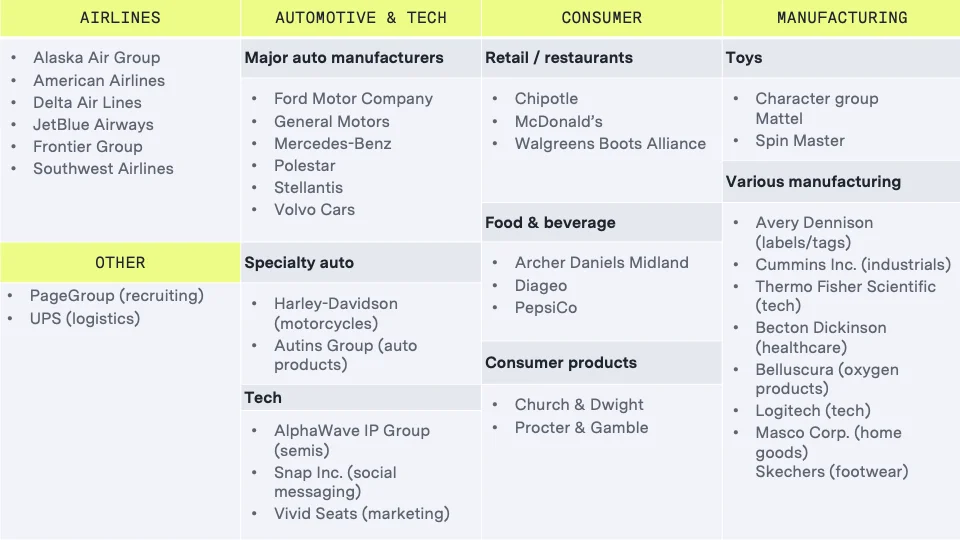
Suspending forward guidance during April / May 2025 earnings season: public companies by sector