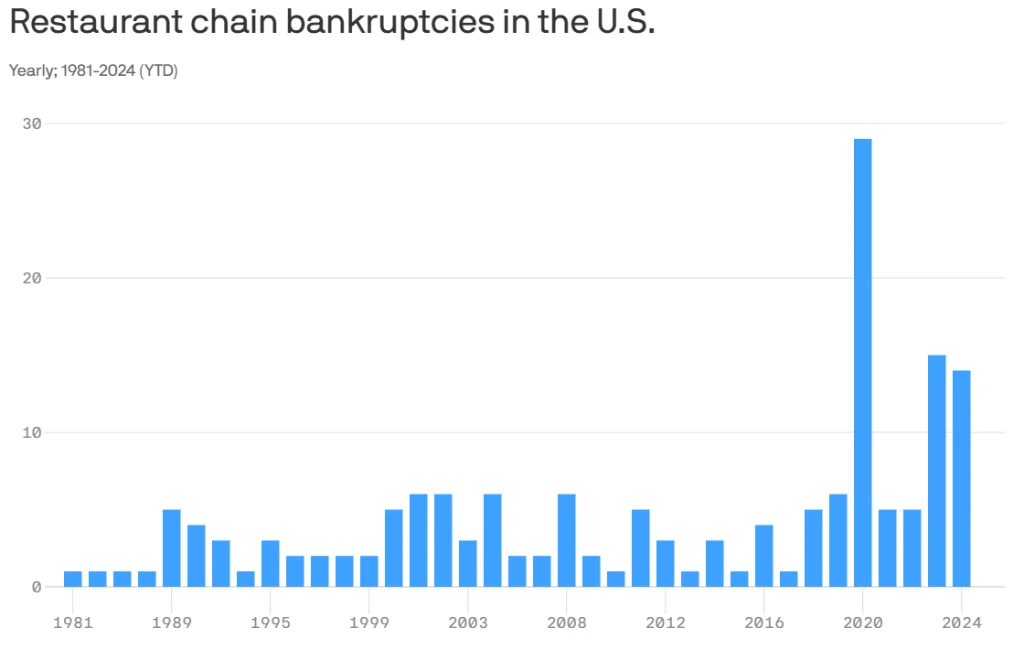
Data: BankruptcyData; Chart: Axios Visuals
Financial sponsors have shied away from distressed restaurant opportunities amid an increasingly challenging macroeconomic backdrop.
Why it matters: With fewer prospective backers, more bankruptcies are likely, but opportunistic buyers could step in next year.
Driving the news: TGI Fridays, which is backed by TriArtisan Capital Advisors and Sentinel Capital Partners, filed for bankruptcy this month.
- Hooters, which was acquired by Nord Bay Capital and TriArtisan Capital Advisors, is in talks with lenders and advisers about its financial woes.
What they’re saying: The pressure on profitability and cash flow is causing financial owners to step back and seek restructuring alternatives instead of trying to grow and exit it, says Charlie Braley, a managing director in the turnaround and restructuring services practice, at AlixPartners.
- Restaurant margins at the venue level sat at around 20% before COVID, but now they’re in the single digits to low teens, Braley says.
- “The time horizon to turn around some of these businesses is too long for their investment,” says Andrew Sharpee, AlixPartners’ co-leader of restaurants, hospitality and travel.
- “And the amount of capital required to really invest back into those businesses just doesn’t meet their return requirements,” he adds.
Zoom out: Consumers are more likely to cut back on the number of times they visit restaurants, versus visiting less-expensive restaurants, according to an AlixPartners report.
- The prices in the food away from home index rose 0.3% in September and August, while the index for prices for full-service meals rose 0.2% over the month, according to the U.S. Bureau of Labor Statistics.
- “You can only control your prices based on what your costs are,” but that requires making sacrifices to your food or labor, Jason Kaplan, CEO of New York-based restaurant consulting company JK Consulting, says.
The latest: At bankruptcy, more lenders are opting to swap their debt for equity before eventually passing them on to more traditional equity investors, says Bain & Co. partner Aaron Cheris.
What’s next: While private equity is shying away from the sector now, that could reverse in 2025, says Nishant Machado, a senior managing director in the finance and restructuring practice of PE consultant Accordion.
- Some sponsors, especially ones with multiple brands, have shown they still have a taste for healthy businesses.
The bottom line: “If you don’t have patient capital, and you don’t have a platform that you can leverage and synergies to drive margin, it makes for a very difficult investment thesis,” Machado says.